

The transition from generative AI to Agentic AI, systems that don’t just chat, but autonomously plan, delegate, and execute, is the defining technological shift of this decade. Gartner predicts that by 2028, 15% of all day-to-day work decisions will be made autonomously by AI agents.
But as enterprises rush to deploy multi-agent systems, they are colliding with a dangerous reality: legacy network security, firewalls, API gateways, and standard IAM, was built for static software, not autonomous, non-deterministic AI.
The result? A security nightmare.
Recent analysis by VentureBeat (OpenClaw can bypass your EDR, DLP, and IAM without triggering a single alert) exposed critical vulnerabilities that bypass every major security tool on the market today. Traditional firewalls are entirely blind to AI traffic because they cannot inspect the semantic intent of a payload.
At Cynapsa, we saw this collision course years ago. To scale Agentic AI, the enterprise doesn’t need a better prompt; it needs a better network.
Cynapsa is the industry’s first network-layer overlay purpose-built for the agentic economy. It replaces the underlying communication fabric with a decentralized, identity-first, and quantum-encrypted mesh. Here is a breakdown of the 4 catastrophic security failures in modern AI architectures, their impact, and how Cynapsa neutralizes them for the world’s most highly regulated industries.
1. Unauthenticated Agent-to-Agent Trust Chains
- The Issue: When agents delegate tasks to other agents or external servers (like Anthropic’s MCP), there is zero mutual authentication. They operate on implicit trust.
- The Impact: A compromised agent automatically inherits the network trust and permissions of every other agent it communicates with. If an attacker breaches a low-level agent, they can move laterally across the entire enterprise ecosystem.
- The Cynapsa Solution: Cynapsa neutralizes this by enforcing an “identity-first” Zero Trust model anchored by quantum-resistant encryption. Before any two agents can communicate, the Cynapsa control plane rigorously authenticates their unique cryptographic identities and explicit delegation rights. Without implicit trust, lateral movement is structurally impossible.
- Banking Use Case: A low-privilege Retail Banking Agent is compromised and attempts to query the highly secure Institutional Wealth Management Agent to scrape high-net-worth client data. Under legacy infrastructure, the internal API gateway allows the ping. Under Cynapsa, the control plane checks the Retail Agent’s identity, verifies it lacks explicit authorization to speak to Wealth Management, and drops the connection instantly.
2. Supply Chain Vulnerabilities and Malicious Skills
- The Issue: The agentic ecosystem relies heavily on third-party tools and open-source skills. Audits reveal that numerous third-party agent skills contain severe security flaws or act as disguised infostealers.
- The Impact: Untrusted code is downloaded and executed in plain text, quietly harvesting sensitive enterprise data like SSH credentials, API keys, and private documents.
- The Cynapsa Solution: Cynapsa’s strict Zero Trust mesh configuration dictates that no entity can participate in the network without explicit, centralized authorization. It is impossible to introduce unvetted third-party agents, external MCPs, or malicious skills because the mesh will simply not recognize, authenticate, or route their traffic.
3. Shadow AI and Untrusted Code Execution on Endpoints
- The Issue: Employees frequently run unauthorized, open-source agentic frameworks on corporate or personal devices without IT approval.
- The Impact: These shadow agents ingest untrusted text from the web and act on it using whatever sensitive corporate VPN configurations or browser tokens they happen to have access to locally.
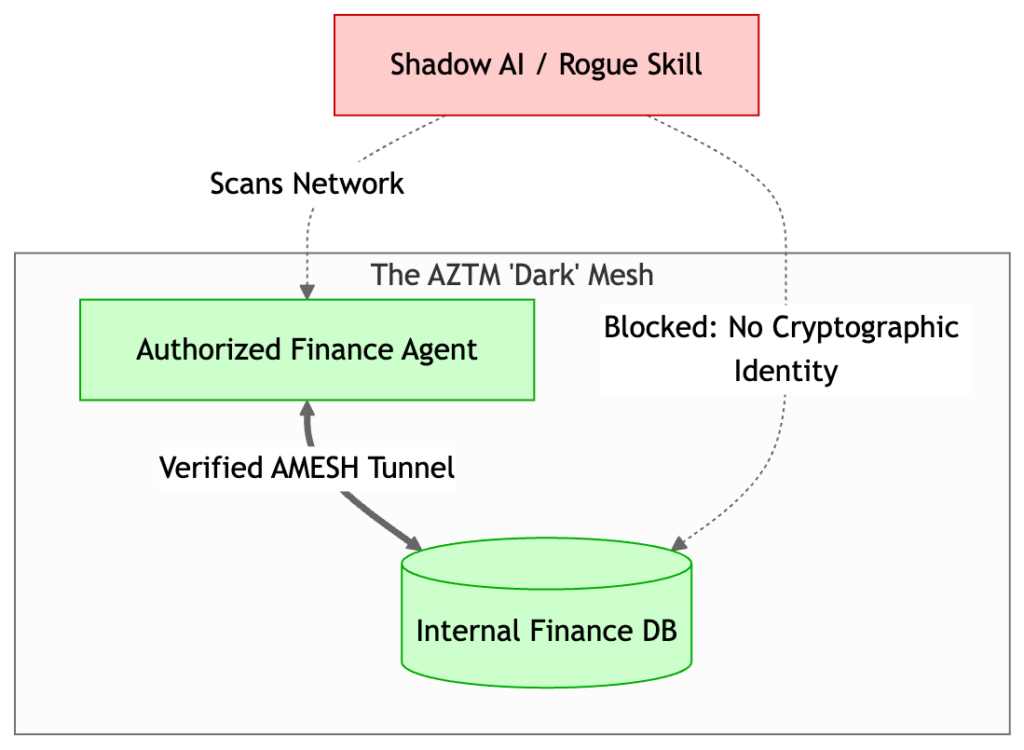
- The Cynapsa Solution: If a rogue “shadow” agent is not explicitly configured on the Cynapsa management server, the Cynapsa control plane denies it all access. Furthermore, legitimate enterprise agents secured by Cynapsa are completely “dark”, meaning they do not respond to unauthorized network pings.
- Corporate Finance / Legal Use Case: A financial analyst runs an unauthorized AI assistant on their laptop to help crunch Q3 numbers. The shadow agent begins scanning the local network for internal databases to “help” index files. Because the enterprise finance and accounting agents are protected by Cynapsa, they are entirely invisible to the shadow AI’s network scans, rendering the rogue tool blind and harmless.
4. Massive Data and Credential Exposures
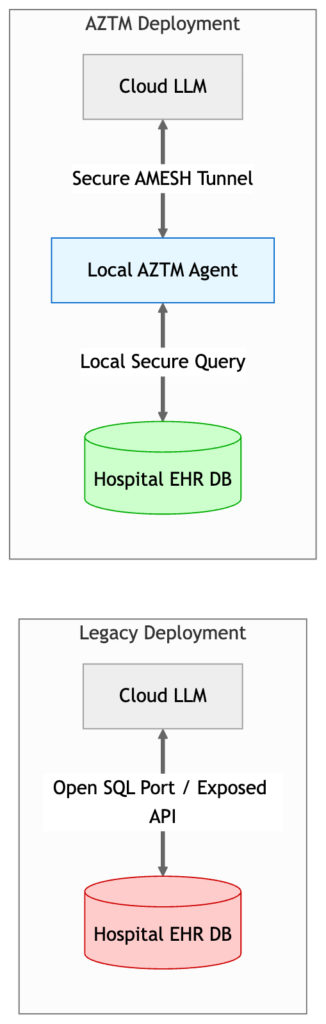
- The Issue: To give AI agents access to company data, legacy frameworks force enterprises to either open firewall ports directly to databases or migrate sensitive data into cloud-hosted AI environments.
- The Impact: This expands the attack surface drastically. Misconfigurations have already led to massive credential leaks, exposing millions of API authentication tokens and providing attackers direct access to backend databases.
- The Cynapsa Solution: Cynapsa elegantly decouples the AI logic from the data. Enterprises can maintain heavy LLMs in the cloud, while the specific agents querying sensitive data operate securely on-premises, right next to the data source. Cynapsa creates a secure, point-to-point Layer 3/Layer 4 connection via AMESH between the cloud and on-prem environments.
- Healthcare Use Case: A hospital network wants to use an advanced cloud-based LLM to analyze patient records for predictive diagnostics. Instead of opening a highly vulnerable SQL port to the cloud, they deploy a Cynapsa-secured agent locally on the hospital servers. Cynapsa creates a secure, encrypted tunnel just for that specific workflow. The proprietary Electronic Health Records (EHR) never leave the hospital perimeter, no SQL ports are exposed, and strict HIPAA compliance is maintained.
The Bottom Line for the Enterprise (and Investors)
The agentic economy cannot run on the rails of the legacy internet. Centralized API gateways fail AI because they cannot handle asynchronous agent traffic without choking on latency or blinding the security team.
Cynpasa solves the trillion-dollar bottleneck effortlessly.
- Frictionless Deployment: It operates entirely in user-space, requires no kernel modules or complex Kubernetes sidecars, and deploys in minutes.
- Absolute Data Sovereignty: Because the Cynapsa control plane never touches the payload, regulated enterprises (Healthcare, Finance, Defense) can adopt cutting-edge AI without compromising compliance.
- Infinite Scalability: The decentralized architecture means we can scale to support millions of global agents without the exorbitant bandwidth costs of proxying data.
We are not just securing AI agents; we are building the foundational fabric that makes distributed, autonomous enterprise AI possible.